
Job-Specific English Content: Why Generic Lessons Are Not Enough for Employee Language Training

Updated: Jun 22

Generic English Content Does Not Always Match the Work
Most English learning content is built for broad use. It teaches common vocabulary, general grammar, everyday conversation, and standard business English topics. That can be helpful, but it often misses the exact reason companies invest in language training for employees.
Employees do not only need to “learn English.” They need to communicate clearly in the situations their jobs require. A field worker may need to explain a delay to a customer. A front desk employee may need to ask follow-up questions. A restaurant employee may need to handle a complaint. A supervisor may need to give instructions, confirm understanding, and help a team member solve a problem.
When the content is too generic, employees may complete lessons without practicing the language they actually need at work.

Your Workplace Materials Become Lessons
One of the biggest advantages of job-specific English training is that the content does not have to come from a generic textbook.
It can come from the materials employees already see at work.
A company may have safety procedures, customer service scripts, work orders, training documents, menus, policies, onboarding materials, job photos, or common customer questions. These materials already contain the language employees need to understand and use.
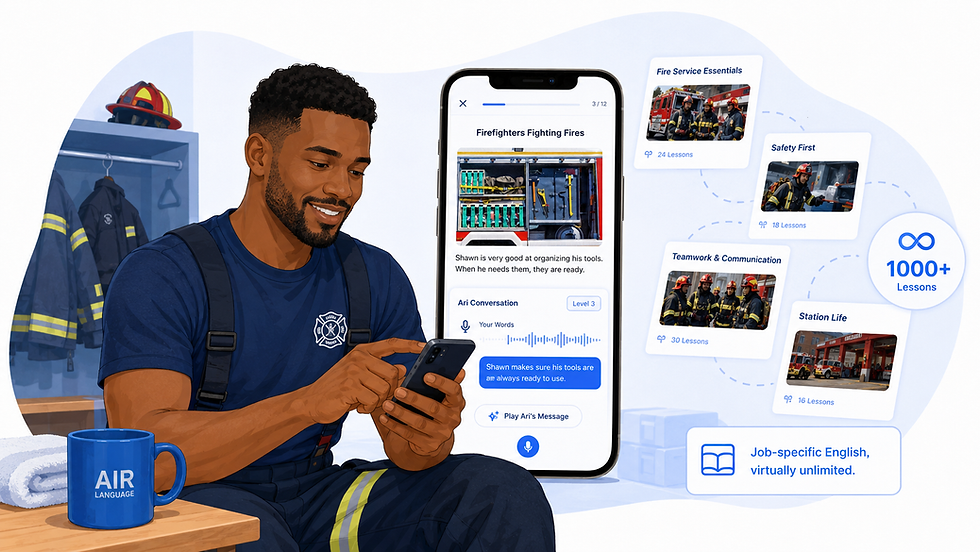
AIR Language can turn those workplace materials into level-appropriate English lessons, vocabulary practice, comprehension questions, speaking tasks, role plays, and live class topics.
That matters because employees are not just practicing English in theory. They are practicing the language connected to their actual job.
For example, a customer complaint can become a speaking task. A safety procedure can become a reading lesson. A work order can become vocabulary practice. A manager’s instructions can become a role-play conversation.
This is what makes the training more useful. Employees get repeated practice with the words, phrases, and situations they are likely to face at work.
What Job-Specific English Content Can Include
Job-specific English content should not feel like a random list of phrases. It should help employees understand real situations, practice useful language, and build confidence using that language with customers, coworkers, and supervisors.
Depending on the company, AIR Language can create content around:
Customer conversations
Safety communication
Scheduling and delays
Phone calls and messages
Workplace questions
Explaining a process
Asking for clarification
Giving updates
Handling complaints
Talking with supervisors
Team communication
Leadership and promotion readiness
Service recovery
Common phrases for daily work
This is where AIR Language’s platform becomes a major advantage. The content does not stay stuck in a PDF or a one-time lesson. Employees can keep practicing through the LMS between live classes, so the language they need stays in front of them throughout the week.

The Platform Makes the Content More Useful
A live class gives employees interaction. A teacher gives guidance. But employees also need repeated exposure and practice outside of class. That is where the AIR Language platform matters.
The LMS allows employees to engage with content connected to their role, their level, and their goals. They can read, listen, practice phrases, answer questions, review vocabulary, and prepare for the conversations they will actually have at work.
For managers, the platform also makes the training more visible. Instead of wondering whether employees are practicing, managers can see participation, completed tasks, reading activity, and progress over time.
That makes job-specific English content more than a lesson topic. It becomes part of a connected training system.
Job-Specific Content Helps Live Classes Work Better
Live classes are more effective when the content is already connected to the job. Instead of spending class time on generic examples, teachers can help employees practice real workplace communication.
A class might focus on how to explain a delay clearly. Another might practice how to ask a customer a follow-up question. Another might help employees respond calmly when someone is frustrated. Another might prepare team members to describe a safety concern or confirm that they understood instructions.
This kind of practice is more useful because employees can immediately recognize where the language fits.
They are not practicing imaginary conversations. They are preparing for the conversations they already have.
Job-Specific English Builds Confidence
Many employees understand more than they are able to say. They may know the job, know the customer, and know what needs to happen next, but still hesitate when they have to explain it in English.
Job-specific content helps close that gap. It gives employees the words, phrases, and practice they need before the moment happens.
Instead of trying to create language from scratch, employees begin to recognize useful patterns:
“Let me check on that for you.”“Just to make sure I understand…”“The reason this happened is…”“What I can do right now is…”“The next step is…”“I’ll explain what we’re going to do.”
These phrases are simple, but they matter. They help employees sound clearer, calmer, and more confident in the moments that shape customer experience and team communication.
Job-Specific Content Also Helps Managers
Managers need more than a promise that employees are “learning English.” They need to know whether training is connected to the business.
Job-specific content makes that easier because the training can be tied to visible workplace goals. If the company wants stronger customer communication, the content can focus on customer conversations. If the company needs safer communication, the content can focus on safety language. If the company wants employees to participate more in team meetings, the content can focus on questions, updates, and explanations.
This also makes feedback more practical. Instead of only saying that a learner needs to improve grammar or vocabulary, instructors can give feedback connected to real work:
“You are improving at asking clarification questions.”“You can explain the basic problem clearly.”“Your next step is practicing more professional customer-service phrases.”“You are ready to practice longer explanations with customers.”“You need more practice confirming instructions before starting a task.”
That kind of feedback is easier for employees to understand and easier for managers to connect to workplace performance.

AIR Language Builds Content Around the Team
AIR Language does not treat corporate language training like a one-size-fits-all program. We build content around the company, the workers, and the communication goals that matter most.
That means the training can reflect the language employees actually need for their jobs. It also means the live classes, platform practice, feedback, and progress reporting all work together instead of feeling disconnected.
Employees get content that makes sense for their work. Teachers get better material for live instruction. Managers get better visibility into progress. The company gets a training program that is easier to understand, easier to use, and easier to connect to real business outcomes.
The Bottom Line
Job-specific English content is one of the biggest differences between generic language training and corporate language training that actually fits the workplace.
When employees practice the English they need for real conversations, training becomes more useful. When that content lives inside a connected platform, employees can keep practicing between classes. When managers can see what employees are doing, language training becomes more measurable.
That is the goal of AIR Language.
The point is simple: employees learn faster when the content is connected to the work they already do. That connection becomes even stronger when the company’s own materials become part of the training.


Comments