
Personalized English Classes for Adults: Learn English for Your Real Life


Adult English learners do not all need the same English.
A parent may need English to talk with a child’s teacher. A restaurant worker may need English to speak with customers and move into a better position. A landscaper may need English to explain services, answer questions, and build trust with clients.
These learners may all be studying English, but they do not need the exact same class.
That is why personalized English classes for adults can be so helpful. Adults need English lessons that match their level, their goals, and their real life. They need useful content, speaking practice, teacher feedback, and a clear plan for what to practice next.
If you are learning English as an adult, you do not need random lessons. You need English that helps you communicate in the situations that matter most to you.
Why Adult Learners Need Personalized English Classes
Adults usually have a clear reason for learning English.
You may need English for work. You may need English to talk with your child’s school. You may need English for appointments, customers, phone calls, neighbors, or everyday conversations. You may also want to feel more confident when people speak quickly or when you need to answer a question.
This is why one-size-fits-all English lessons often do not work well for adults.
A beginner who works in a restaurant needs different practice from a parent preparing for a school meeting. A landscaper who talks with clients needs different English from someone who works in an office. A learner who understands English but cannot speak confidently needs different support from someone who is just starting.
Personalized English classes help because they begin with the learner.
They ask important questions:
What is your level?Why do you need English?Where do you feel stuck?What conversations do you need to have?What should you practice this week?
When English class starts with those questions, learning becomes more useful.
A Parent Who Wants to Talk With Their Child’s Teacher
For many parents, English is not just about personal growth. It is about family.
A parent may want to ask a teacher how their child is doing. They may want to understand school messages, talk about homework, attend a parent-teacher conference, or ask what their child needs to practice.
This can feel stressful.
Even if a parent understands some English, speaking in a school meeting can be difficult. The teacher may speak quickly. The parent may worry about using the wrong words. They may want to ask a question but not know how to say it clearly.
A personalized English class can help that parent practice the exact conversations they need.
For example, the parent might practice saying:
“How is my child doing?”“What does my child need to practice?”“Can you explain this assignment?”“Can we schedule a meeting?”“How can I help my child at home?”
These are not random textbook sentences. These are real sentences a parent may need.
A good English teacher can also help the parent prepare for a real meeting. The teacher can practice the conversation, correct mistakes, explain useful vocabulary, and help the parent feel more confident.
That is the power of personalized English learning. It connects class to real life.
A Restaurant Worker Who Wants to Advance
A restaurant worker may need English every day.
They may need to greet customers, take orders, explain menu items, talk with coworkers, ask a manager a question, or respond when something goes wrong.
At first, basic English may be enough to get through the shift. But if the worker wants to advance, English becomes even more important.
Maybe they want to become a shift lead. Maybe they want to train new employees. Maybe they want to talk more confidently with customers. Maybe they want their manager to see that they are ready for more responsibility.
A personalized English class can help by focusing on restaurant English and workplace communication.
The learner might practice sentences like:
“The customer has a question.”“We are out of that item today.”“I can help train the new employee.”“I would like to learn more responsibilities.”“Can you show me how to do that?”“I handled the problem with the customer.”
This kind of English is practical. It helps the learner speak more clearly at work. It also helps them build confidence for future opportunities.
A good teacher can go even further. The teacher might give the learner a real-world task, such as asking three coworkers how they handle difficult customers. Then the learner brings those answers back to class and practices explaining what they learned.
That kind of task helps with speaking, listening, vocabulary, and confidence.
It also makes English feel useful immediately.
A Landscaper Who Wants to Connect With Clients
A landscaper may do excellent work, but still feel limited by English.
They may want to explain what was finished, answer a client’s question, talk about a schedule change, ask about a gate, discuss a sprinkler problem, or build more trust with customers.
This is a perfect example of why personalized English classes matter.
A landscaper does not need random English about topics that never appear at work. They need English connected to yards, tools, weather, schedules, services, prices, and customer communication.
They may need to say:
“We finished the front yard.”“Would you like us to trim this area?”“There is a problem with the sprinkler.”“We can come back tomorrow.”“The gate was locked when we arrived.”“Do you want us to remove these branches?”
These sentences help the worker communicate clearly and professionally.
They also help the worker connect with clients. Better communication can build trust. It can reduce confusion. It can help customers feel heard and respected.
For a landscaper, English is not just a school subject. It is part of customer service, career growth, and business opportunity.
A personalized English class should recognize that.
Personalized Classes Start With Your Level
Before you can build a strong English plan, you need to know your level.
Many adults describe their English in general ways. They may say, “My English is bad,” or “I understand but I can’t speak,” or “I know some English, but I need more practice.”
Those feelings are real, but they do not give enough information.
A good English level test can help you understand what you already know and what you should practice next. Maybe you need help with basic sentences. Maybe you need more speaking confidence. Maybe you need better pronunciation. Maybe you need job-specific vocabulary. Maybe you need practice answering questions in complete sentences.
When you know your level, your class can be more focused.
You do not waste time on lessons that are too easy. You do not get lost in lessons that are too hard. You begin in the right place.
That is why personalized English classes for adults should start with a clear understanding of the learner’s level and goals.
Personalized Classes Use Content That Matches Your Life
Content matters.
Many English learners spend time studying lessons that do not connect to their daily life. They may watch random videos, memorize random words, or complete grammar exercises that never help them speak in real situations.
That can be frustrating.
Personalized English classes should use content that matches the learner’s life.
A parent should practice school conversations, teacher messages, forms, meetings, homework, and questions about their child. A restaurant worker should practice customer service, food orders, schedules, complaints, and workplace conversations. A landscaper should practice customer questions, tools, weather, services, schedules, and common job problems.
When content matches your life, English becomes easier to remember.
You see the same words again and again. You hear phrases that you may actually use. You practice conversations that prepare you for real moments.
This is one reason AIR Language focuses on useful content matched to the learner’s level and goals.
Adult learners need English that helps them do something.
Personalized Classes Give You Real Speaking Tasks
A strong English class should not stop when the class ends.
For adults, one of the best ways to learn English is to complete small speaking tasks in real life.
These tasks should be simple, useful, and connected to the learner’s goals.
A parent might practice asking a teacher one question after school or preparing for a parent-teacher conference. A restaurant worker might ask three coworkers how they handle a difficult customer. A landscaper might practice explaining a schedule change to a client or asking a customer about a specific service.
Then, in the next class, the learner talks about what happened.
This creates a powerful learning cycle.
The learner prepares in class. Then they use English in real life. Then they return to class, explain what happened, and get feedback.
That is much stronger than only memorizing words.
Real speaking tasks help learners build confidence because they prove that English can be used outside the classroom.
Personalized Classes Include Teacher Feedback
Practice matters, but feedback helps you improve faster.
Without feedback, learners may keep making the same mistakes. They may not know what sounds clear and what sounds confusing. They may also fail to notice when they are improving.
A teacher can help the learner understand what to fix next.
For example, a teacher might say, “Your meaning was clear, but let’s practice the past tense.” Or, “That sentence makes sense, but here is a more natural way to say it.” Or, “You used a good phrase. Now let’s practice using it in a longer answer.”
Good feedback should not embarrass the learner. It should give direction.
This is especially important for adults because adult learners often have limited time. They need to know what to practice next. They need clear steps.
Personalized English classes with teacher feedback help learners avoid guessing.
They help learners keep moving forward.
Personalized English Classes Are Not Just Private Lessons
When people hear “personalized English classes,” they may think it only means private tutoring.
But personalized learning can happen in different ways.
A class can be personalized when the teacher understands the learner’s level, goals, and needs. It can be personalized when the content matches the learner’s life. It can be personalized when learners get feedback and real tasks to complete outside of class.
The most important thing is not whether the class is private or group.
The most important thing is whether the class helps the learner practice the English they actually need.
For many adults, a strong class includes both structure and flexibility. The learner needs a clear plan, but that plan should connect to real goals.
That is what makes English learning feel useful.
How AIR Language Helps Adults Learn Practical English
AIR Language helps adults learn practical English for work, school conversations, and everyday life.
Our online English classes are built around the idea that learners need more than random lessons. They need a level, a plan, useful content, speaking practice, teacher feedback, and real-world tasks.
A parent can practice English for school meetings and teacher conversations. A restaurant worker can practice English for customers, coworkers, and career growth. A landscaper can practice English for client communication, schedules, services, and job updates.
Every learner is different.
That is why AIR Language focuses on personalized English classes for adults who want to use English in real life.
You do not need perfect English to begin. You need the right support and a clear next step.
Learn more about our online English classes for adults.
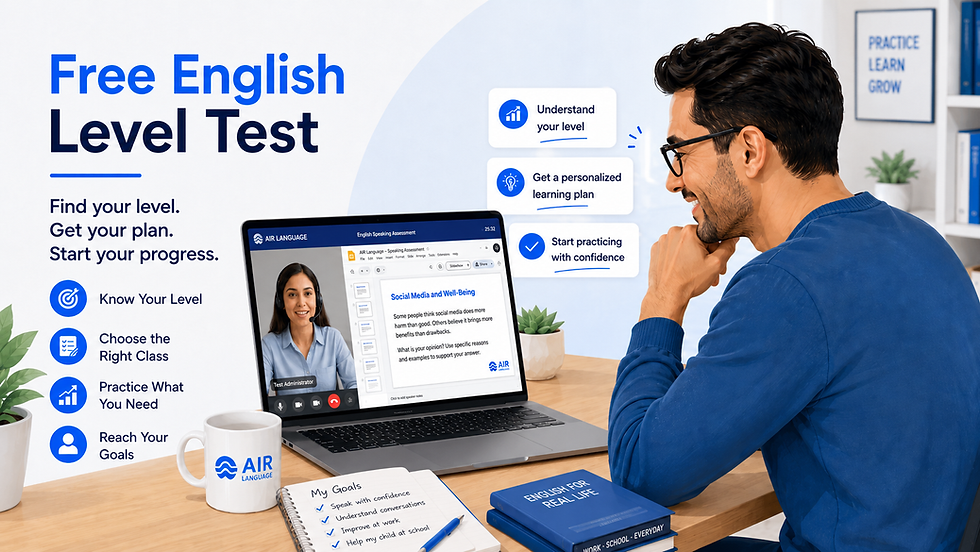
Start With a Free English Language Test
If you are looking for personalized English classes for adults, the best first step is to understand your level.
A free English language test can help you see what you already know and what you should practice next. It can also help you build a plan for your goals.
At AIR Language, we help adult learners improve practical English with online classes, useful content, speaking practice, teacher feedback, and real-life tasks.
Whether you need English for work, your child’s school, clients, customers, appointments, or daily life, you can start with one simple step.
FAQ
What are personalized English classes?
Personalized English classes are English lessons based on your level, goals, and real-life needs. They may include speaking practice, useful content, teacher feedback, and a plan for what to practice next.
Are personalized English classes good for adults?
Yes. Personalized English classes can be very helpful for adults because adults often need English for specific situations, such as work, school conversations, customers, appointments, or daily life.
How are personalized English classes different from regular English classes?
Regular English classes often give every learner the same lesson. Personalized English classes focus on your level, your goals, and the English you actually need to use.
Can personalized English classes help with work?
Yes. Personalized English classes can help you practice workplace English, customer conversations, job-specific vocabulary, schedules, instructions, and speaking with coworkers or managers.
Can parents take personalized English classes?
Yes. Parents can take personalized English classes to practice talking with teachers, understanding school messages, asking questions, and communicating more confidently in daily life.
How can AIR Language help me learn English?
AIR Language helps adults learn practical English through online classes, level-based content, speaking practice, teacher feedback, real-life tasks, and a personalized learning plan.

Comments